Tell us about the job
Takes about a minute. No obligation.
A contractor quoting a furnace installation in Summers County starts with the house: how it is insulated, how old the ductwork is, and what the existing equipment tells them about how the structure holds heat. 64 severe weather events were recorded in Summers County, West Virginia between 2015 and 2024. At that rate, severe weather is an occasional fact of life here rather than a sustained workload, and it does not drive the sizing conversation the way it would in harder-hit areas. What does drive it is the condition of the home itself, and a contractor who skips that assessment will mismatch the equipment to the structure.
Older ductwork sized for a different system can restrict airflow enough that a new furnace runs short of what it was rated for, and a contractor has to assess that before anything else on an installation job. Half the homes in Summers County, West Virginia were built in 1974 or earlier (2020-2024 ACS 5-year). A house built that long ago was laid out for equipment with different heating loads, and the duct runs that made sense then may be too narrow, too leaky, or routed in ways that create dead zones under a modern unit. The electrical service gets the same look: a new furnace draws what it draws, and the existing panel either supports that or it does not.
What Gets Installed With a New Furnace
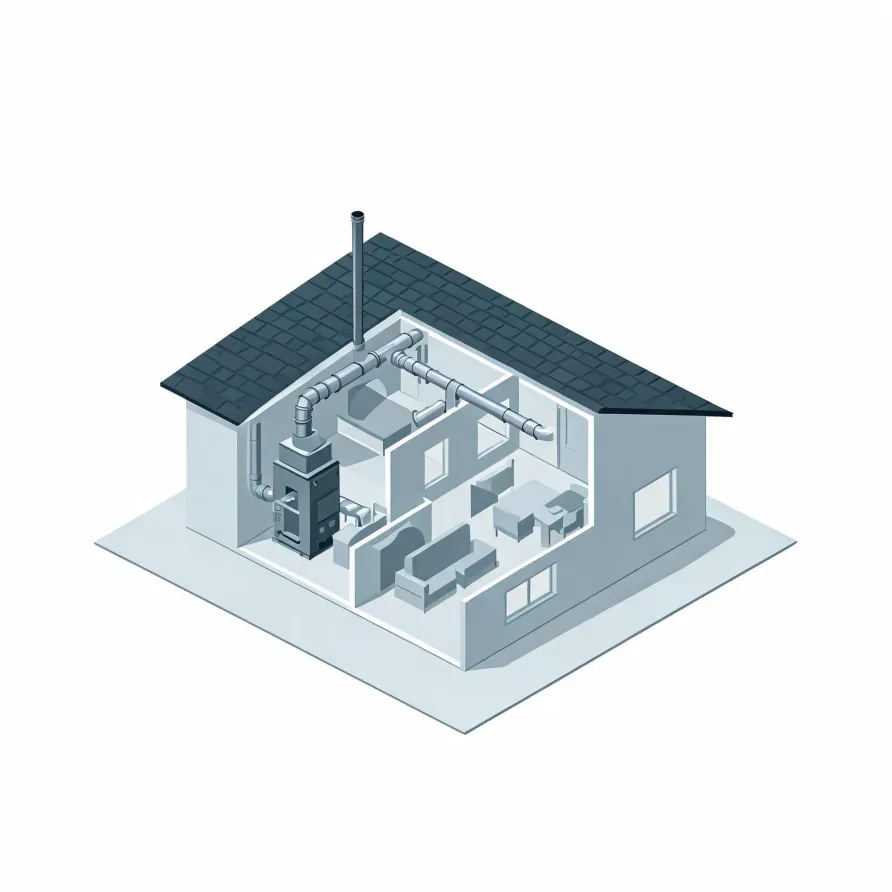
The furnace itself sits in a mechanical room, basement, or utility closet and is the core of what gets purchased and placed. A contractor mounts the unit, connects it to the fuel supply, and ties it into the home's air distribution system. That box is what a homeowner is buying when they commission a new installation.
The flue pipe runs from the furnace to an exterior termination point, carrying combustion exhaust safely out of the house. Alongside the furnace, a contractor also places or replaces the air handler components that move conditioned air into the duct openings, and sets the thermostat that gives the homeowner control over the whole system.
The drawing shows a general layout of these components, and a licensed contractor determines exactly what applies to this house.
Find a contractor in Summers CountySummers County by the Numbers
64 severe weather events were recorded in Summers County, West Virginia between 2015 and 2024.
NOAA National Centers for Environmental Information, Storm Events Database, bulk CSV export, events 2015-01-01 through 2024-12-31.Half the homes in Summers County, West Virginia were built in 1974 or earlier (2020-2024 ACS 5-year).
U.S. Census Bureau, 2020-2024 American Community Survey 5-Year EstimatesSummers County, West Virginia holds 6,541 housing units (2020-2024 ACS 5-year).
U.S. Census Bureau, 2020-2024 American Community Survey 5-Year EstimatesOwners occupy 81.2% of the occupied homes in Summers County, West Virginia (2020-2024 ACS 5-year).
U.S. Census Bureau, 2020-2024 American Community Survey 5-Year EstimatesCodes & Standards Governing Furnace Installation in Summers County, West Virginia5 sourced rules and standards
What happens when the contractor comes out
Non-weatherized gas furnaces manufactured on or after November 19, 2015 must reach 80.0 percent AFUE.
Non-weatherized oil-fired furnaces manufactured on or after November 19, 2015 must reach 83.0 percent AFUE.
Mobile home gas furnaces manufactured on or after November 19, 2015 must reach 80.0 percent AFUE.
Non-weatherized gas furnaces manufactured on or after December 18, 2028 must reach 95.0 percent AFUE, up from the 80.0 percent minimum that applies to units manufactured before that date.
Licensing and Legal Requirements in Summers County, West Virginia
West Virginia requires a licence from the Commissioner of Labor to perform, or offer to perform, work on a heating, ventilating and cooling system.
Severe Weather History in Summers County
Local weather puts direct load on heating equipment, and that load shapes what a furnace needs to handle over its life. A contractor sizing and installing equipment here works from conditions that are specific to this area.
64 severe weather events, 2015–2024. Source: NOAA National Centers for Environmental Information, Storm Events Database.