Tell us about the job
Takes about a minute. No obligation.
A furnace repair in Hampshire County calls for a contractor who works out what actually failed before settling on a cause. 112 severe weather events were recorded in Hampshire County, West Virginia between 2015 and 2024. That record puts severe weather in this area as a real but not overwhelming presence, which means it cannot carry the full explanation when a heat exchanger cracks or a blower motor quits. Age of the equipment and how consistently it has been serviced are the first things a contractor checks, because those factors account for most of what gets found on a repair call here.
Older furnaces in houses like these were built around components that manufacturers have since discontinued, revised, or consolidated into different product lines. Half the homes in Hampshire County, West Virginia were built in 1986 or earlier (2020-2024 ACS 5-year). A contractor who opens a furnace here and finds a failed heat exchanger, a cracked inducer housing, or a worn control board is not always looking at a straightforward swap. Whether the part the system needs is still in production, and what its current equivalent actually fits, is where the repair scope gets decided.
The Parts of a Furnace a Contractor Checks First
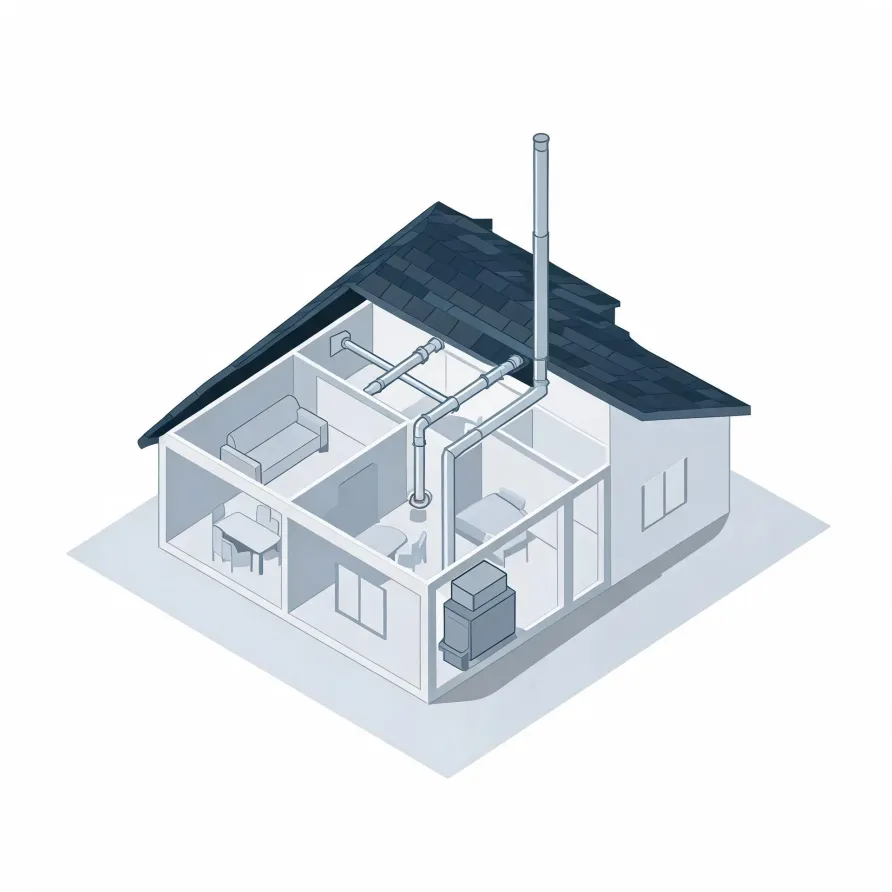
The furnace itself sits in a basement, utility closet, or mechanical room and is where heat is actually produced. Inside it, the heat exchanger is the part a contractor looks at closely during a repair call. Cracks or failures there affect both performance and safety.
The blower motor pushes conditioned air out through the ducts and is a common source of noise complaints or airflow problems. The flue or venting pipe runs from the furnace to the outside and matters when combustion gases are not clearing properly. The thermostat and its wiring tie the whole system together, and a fault there can look like a furnace problem even when the furnace itself is fine.
The drawing shows a general layout of these components, and a licensed contractor determines what applies to your specific setup.
Find a contractor in Hampshire CountyHampshire County by the Numbers
112 severe weather events were recorded in Hampshire County, West Virginia between 2015 and 2024.
NOAA National Centers for Environmental Information, Storm Events Database, bulk CSV export, events 2015-01-01 through 2024-12-31.Half the homes in Hampshire County, West Virginia were built in 1986 or earlier (2020-2024 ACS 5-year).
U.S. Census Bureau, 2020-2024 American Community Survey 5-Year EstimatesHampshire County, West Virginia holds 12,639 housing units (2020-2024 ACS 5-year).
U.S. Census Bureau, 2020-2024 American Community Survey 5-Year EstimatesOwners occupy 82.7% of the occupied homes in Hampshire County, West Virginia (2020-2024 ACS 5-year).
U.S. Census Bureau, 2020-2024 American Community Survey 5-Year EstimatesCodes & Standards Governing Furnace Repair in Hampshire County, West Virginia5 sourced rules and standards
What HVAC Repair Looks Like in Hampshire County
Non-weatherized gas furnaces manufactured on or after November 19, 2015 must reach 80.0 percent AFUE.
Non-weatherized oil-fired furnaces manufactured on or after November 19, 2015 must reach 83.0 percent AFUE.
Mobile home gas furnaces manufactured on or after November 19, 2015 must reach 80.0 percent AFUE.
Non-weatherized gas furnaces manufactured on or after December 18, 2028 must reach 95.0 percent AFUE, up from the 80.0 percent minimum that applies to units manufactured before that date.
Licensing and Legal Requirements in Hampshire County, West Virginia
West Virginia requires a licence from the Commissioner of Labor to perform, or offer to perform, work on a heating, ventilating and cooling system.
Severe Weather Events in Hampshire County
Weather places real demands on furnace equipment, and those demands vary by where you live. A local pattern of severe events tells you something about how hard heating systems in Hampshire County have to work and how often they get stressed into needing repair.
112 severe weather events, 2015–2024. Source: NOAA National Centers for Environmental Information, Storm Events Database.