Tell us about the job
Takes about a minute. No obligation.
A contractor called out for furnace repair in Lincoln County starts by asking how the system has been maintained and how old the heat exchanger and ignition components are. 83 severe weather events were recorded in Lincoln County, West Virginia between 2015 and 2024. At that rate, severe weather is a real but occasional factor in a furnace's working life, not the standing condition it becomes in harder-hit areas. A system that has been skipping annual service and running on original parts for years is going to fail on its own terms. The weather record belongs in the conversation, but it rarely accounts for what a contractor actually finds inside a Lincoln County furnace.
Ductwork and wiring fitted to a house stay in place long after the original furnace is gone, but the furnace itself cycles out, and what runs in these houses now is often several generations of equipment removed from what was first installed. Half the homes in Lincoln County, West Virginia were built in 1983 or earlier (2020-2024 ACS 5-year). That gap is where a repair job gets complicated. Once a contractor opens the unit, the question is whether the components it takes are still manufactured or have to be sourced as old stock, and that answer shapes the repair bill more than the labor does. A heat exchanger or control board in a system that old can run the cost well past what a straightforward fix would look like on paper.
The Parts of a Furnace a Contractor Checks First
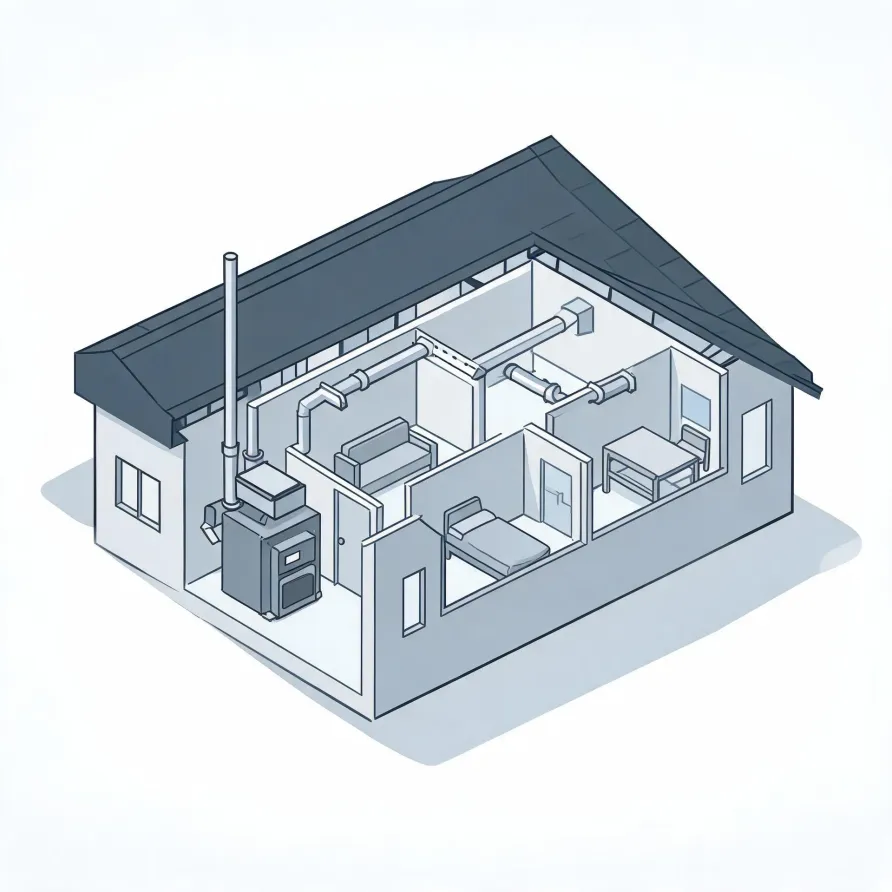
The furnace itself sits in a utility area, basement, or closet and is the piece doing the actual heating work. Inside it, the heat exchanger is what a contractor looks at hard during a repair call. Cracks or failures there are a safety matter, not just a comfort one. The burner assembly, which produces the flame, and the ignitor, which starts it, are the other components a contractor reaches for early when a furnace stops firing.
The blower motor and its fan wheel sit inside the furnace cabinet and push conditioned air into the duct system. The flue or exhaust vent runs from the cabinet up and out of the house, carrying combustion gases away. The control board ties the electrical signals together, and when a furnace behaves erratically, that board is often where a contractor traces the fault.
The drawing shows the general layout of a furnace system, and a licensed contractor determines which components apply to the specific equipment and conditions in your home.
Find a contractor in Lincoln CountyLincoln County, WV, by the numbers
83 severe weather events were recorded in Lincoln County, West Virginia between 2015 and 2024.
NOAA National Centers for Environmental Information, Storm Events Database, bulk CSV export, events 2015-01-01 through 2024-12-31.Half the homes in Lincoln County, West Virginia were built in 1983 or earlier (2020-2024 ACS 5-year).
U.S. Census Bureau, 2020-2024 American Community Survey 5-Year EstimatesLincoln County, West Virginia holds 9,595 housing units (2020-2024 ACS 5-year).
U.S. Census Bureau, 2020-2024 American Community Survey 5-Year EstimatesOwners occupy 74.5% of the occupied homes in Lincoln County, West Virginia (2020-2024 ACS 5-year).
U.S. Census Bureau, 2020-2024 American Community Survey 5-Year EstimatesCodes & Standards Covering Furnace Repair in Lincoln County, West Virginia5 sourced rules and standards
What Repair Work Looks Like in Lincoln County
Non-weatherized gas furnaces manufactured on or after November 19, 2015 must reach 80.0 percent AFUE.
Non-weatherized oil-fired furnaces manufactured on or after November 19, 2015 must reach 83.0 percent AFUE.
Mobile home gas furnaces manufactured on or after November 19, 2015 must reach 80.0 percent AFUE.
Non-weatherized gas furnaces manufactured on or after December 18, 2028 must reach 95.0 percent AFUE, up from the 80.0 percent minimum that applies to units manufactured before that date.
Licensing Rules for HVAC Repair in Lincoln County, West Virginia
West Virginia requires a licence from the Commissioner of Labor to perform, or offer to perform, work on a heating, ventilating and cooling system.
Severe Weather Events in Lincoln County
Weather puts real strain on furnace equipment. Hard winters, sudden cold snaps, and power fluctuations from storms all push heating systems toward failure, and what Lincoln County sees in a given year shapes how hard local furnaces have to work.
83 severe weather events, 2015–2024. Source: NOAA National Centers for Environmental Information, Storm Events Database.