Tell us about the job
Takes about a minute. No obligation.
A furnace repair in Wayne County calls for a contractor who can sort out what actually wore the system down. 100 severe weather events were recorded in Wayne County, West Virginia between 2015 and 2024. At that rate, severe weather is a steady background condition rather than a rare event, and it adds real load to heat exchangers, igniters, and blower motors over years of service. But a component that has failed here probably did not fail on weather alone. A contractor will look at installation quality and maintenance history before weather becomes the explanation, because in most cases those are what determine whether a part holds or gives out first.
Older furnaces in a house built before parts catalogs went digital draw from a shallow supply. Half the homes in Wayne County, West Virginia were built in 1976 or earlier (2020-2024 ACS 5-year). A contractor opening a heat exchanger or a control board in stock this old has to check parts availability before the repair scope means anything, because a fix that looks straightforward stalls when the component is no longer made. That is the variable that decides whether a repair is a morning's work or a conversation about replacement.
The Parts of a Furnace a Contractor Checks First
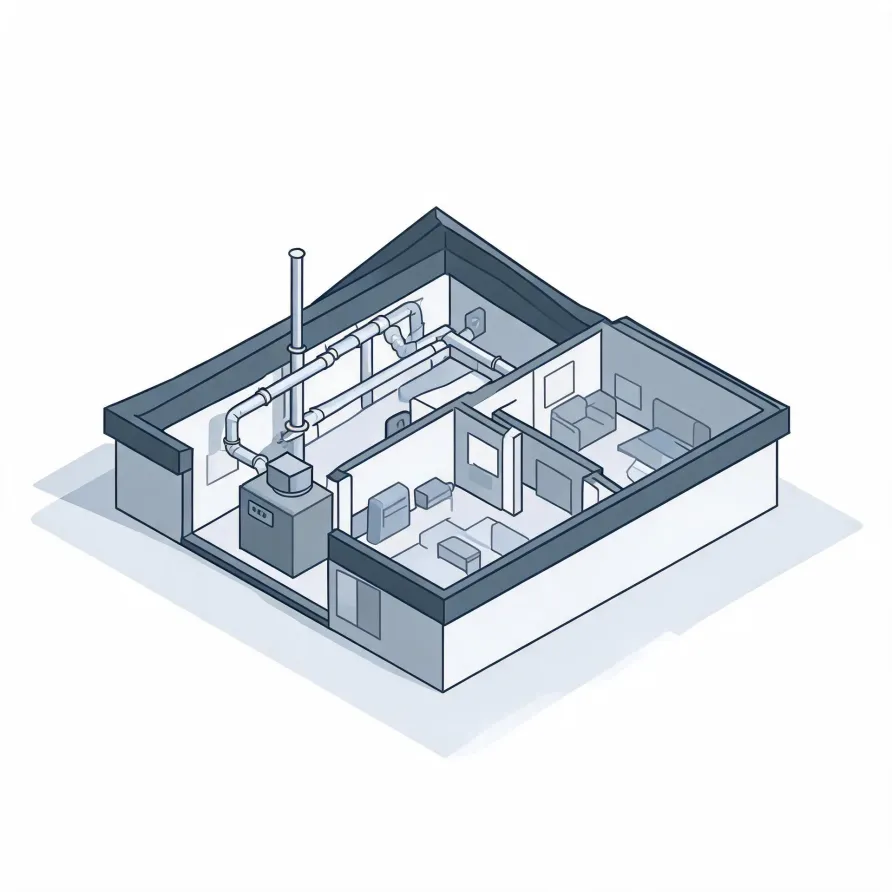
The heat exchanger sits at the core of the furnace cabinet and is where combustion gases warm the air your home circulates. Cracks or rust here let those gases mix with living-space air, so it is one of the first places a contractor looks. The burner assembly sits just below it, and a contractor checks it closely when the furnace fails to light or runs unevenly.
The blower motor and its fan wheel sit in the lower half of the cabinet and push conditioned air out through the supply plenum. The control board, mounted inside the cabinet, reads every sensor signal and fires every component in sequence. When a furnace behaves erratically or shuts itself off early, a contractor traces the fault through both of these before moving elsewhere.
The drawing shows a typical furnace layout, and a licensed contractor determines what applies to the specific equipment and configuration in your home.
Find a contractor in Wayne CountyWayne County, WV, by the numbers
100 severe weather events were recorded in Wayne County, West Virginia between 2015 and 2024.
NOAA National Centers for Environmental Information, Storm Events Database, bulk CSV export, events 2015-01-01 through 2024-12-31.Half the homes in Wayne County, West Virginia were built in 1976 or earlier (2020-2024 ACS 5-year).
U.S. Census Bureau, 2020-2024 American Community Survey 5-Year EstimatesWayne County, West Virginia holds 18,263 housing units (2020-2024 ACS 5-year).
U.S. Census Bureau, 2020-2024 American Community Survey 5-Year EstimatesOwners occupy 78.6% of the occupied homes in Wayne County, West Virginia (2020-2024 ACS 5-year).
U.S. Census Bureau, 2020-2024 American Community Survey 5-Year EstimatesCodes & Standards Governing Furnace and HVAC Repair in Wayne County, West Virginia5 sourced rules and standards
What happens when the contractor comes out
Non-weatherized gas furnaces manufactured on or after November 19, 2015 must reach 80.0 percent AFUE.
Non-weatherized oil-fired furnaces manufactured on or after November 19, 2015 must reach 83.0 percent AFUE.
Mobile home gas furnaces manufactured on or after November 19, 2015 must reach 80.0 percent AFUE.
Non-weatherized gas furnaces manufactured on or after December 18, 2028 must reach 95.0 percent AFUE, up from the 80.0 percent minimum that applies to units manufactured before that date.
Licensing Rules for HVAC Work in Wayne County, West Virginia
West Virginia requires a licence from the Commissioner of Labor to perform, or offer to perform, work on a heating, ventilating and cooling system.
Severe Weather Events in Wayne County
Extreme weather puts real strain on furnace systems, driving the kind of wear that turns into repair calls. How often that pressure hits in Wayne County shapes what local contractors work on and how equipment holds up over time.
100 severe weather events, 2015–2024. Source: NOAA National Centers for Environmental Information, Storm Events Database.